

Howdy folks,
I had one of my smooth-skinned acros (I think it was a ‘Red Ferrari’ frag) up and RTN on me this week after growing well for 3 months. I tried fragging off the remaining healthy-looking piece but no dice- gone the next morning. All other corals and inverts, including a small (1.6”) crocea clam, healthy and growing. The acro that RTN’d was in a sort of nook in the rock work on the far side of the tank which is a pretty low-flow area. I also had my return pump lose power on me about a month ago so I’m using a less powerful backup until the replacement comes from the manufacturer. So I suspect it was a flow issue? Especially given the location of the frag that died. I don’t have a wavemaker/secondary powerhead in this tank for aesthetic reasons- it’s a peninsula on the raised bar area of my kitchen/living room and I don’t like wires running everywhere. But obviously wires look better than a tank of dead coral so I can add one if that’s what’s going on.
I know RTN has myriad causes and it can be very difficult to pinpoint, but in a tank with very low nutrients and stable parameters this is all I can think of. It does not appear to have spread (as of yet) to any other corals and I feel like if it was microbial in origin (vibrio etc) I would’ve seen others affected by now. Photo shows the acro that melted so you can see location in the tank.
In case anyone needs the following info, here you go:
21G UNS AIO peninsula tank
Kessil AP9X
RO/DI water, AquaVitro Salinity 1.025
Temp stable at 80 (though I did dial it down a degree today in case temp was a potential factor?)
pH 8-8.2 across the day
KH 8
NO3: 0.2
Phos: 0.06
Ca: 420
Mg: 1350
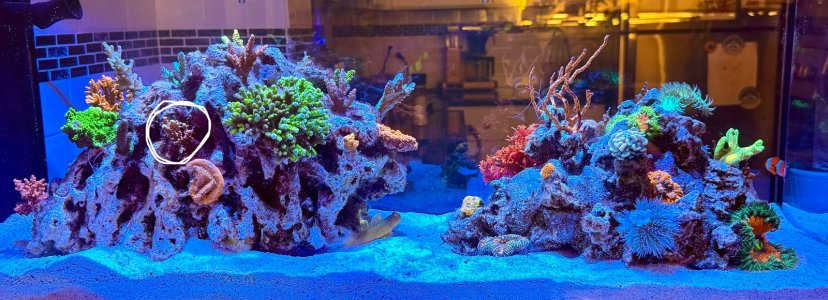
I had one of my smooth-skinned acros (I think it was a ‘Red Ferrari’ frag) up and RTN on me this week after growing well for 3 months. I tried fragging off the remaining healthy-looking piece but no dice- gone the next morning. All other corals and inverts, including a small (1.6”) crocea clam, healthy and growing. The acro that RTN’d was in a sort of nook in the rock work on the far side of the tank which is a pretty low-flow area. I also had my return pump lose power on me about a month ago so I’m using a less powerful backup until the replacement comes from the manufacturer. So I suspect it was a flow issue? Especially given the location of the frag that died. I don’t have a wavemaker/secondary powerhead in this tank for aesthetic reasons- it’s a peninsula on the raised bar area of my kitchen/living room and I don’t like wires running everywhere. But obviously wires look better than a tank of dead coral
so I can add one if that’s what’s going on. I know RTN has myriad causes and it can be very difficult to pinpoint, but in a tank with very low nutrients and stable parameters this is all I can think of. It does not appear to have spread (as of yet) to any other corals and I feel like if it was microbial in origin (vibrio etc) I would’ve seen others affected by now. Photo shows the acro that melted so you can see location in the tank.
In case anyone needs the following info, here you go:
21G UNS AIO peninsula tank
Kessil AP9X
RO/DI water, AquaVitro Salinity 1.025
Temp stable at 80 (though I did dial it down a degree today in case temp was a potential factor?)
pH 8-8.2 across the day
KH 8
NO3: 0.2
Phos: 0.06
Ca: 420
Mg: 1350


