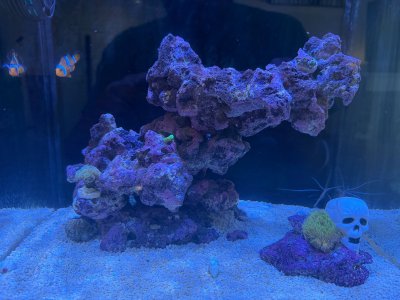
Wow thank you so much for the extremely thoughtful response! I read it last night and it gave me a lot to think about!
(Part 1 of 2)
My pleasure, glad it was well received. I know it was a lot - I can definitely be verbose, I know - but you kind of have a lot going on, and I hope people would rather know and be able to prepare and plan, rather than be told what they want to hear. Especially in this hobby, where you simply can't ever know "enough".
I've also read the same about the clownfish and dottyback AFTER I got them on all the AI LLMs and I think in the back of my mind I was hoping they'd be wrong. Then after reading your message, I figured I should go ahead and expect to have to rehome the dottyback at some point. Well I told my wife and daughter that and they both lost it and asked me why we can't just get another bigger tank

!! So thank you! I think I just got permission to upgrade!!

Yeah, no, I feel you. For reference, I tore my last reef down in early 2008. I finally put water in my second (and current) reef in April of 2025: I spent 17 years thinking about my next tank and what I wanted from it. In the time since I got the lights for this tank (Dec 2024) till now (my tank won't get its first fish until about another 7 or 8 weeks) I've done a LOT of reading on what kinds of fish I want to stock my tank with - both the royal gramma and the dottyback came up for their amazing coloration, but as I want a peaceful community reef (I'm
so over aggressive fish and the constant hassle) and have a smaller footprint (believe it or not, 50 gallons is still on the small side for a reef) I had to exclude both from my plan. When I saw your post, alarm bells immediately went off, so off I went back to my normal sources. Then I asked the AI's, one after another, and all of them jived the same way, picking out that pairing immediately as trouble in that small volume.
Still, that's hilariously awesome that the wife and kiddo are invested thanks to that pretty fish

Personally I'd suggest no less than 75 gallons with a full sump if you can manage it. 50, at the minimum, if you want to keep both those fish in the same tank. No reason you can't run both tanks at the same time, either, tho!
IN FACT, I have a 15-gallon cube hooked up to my 50-gallon as a refugium! It DID have to be drilled, first, though: I would never trust an overflow box for this kind of setup.
View attachment 110927
(
old pic!: the frag rack on the front glass was temporary, lol, don't roast me

yes, the two tanks normally reverse-lit: the main tank is on from 2:30 - 10:30pm, the cube is lit the other 16 hours of the day, but it's technically a "display refugium" and part of my filter system, not just another fish tank sharing the same water)
Still, the bigger the tank you can manage (yes, they obviously come with increased costs for lighting and filter equipment), the easier it will be to stock, manage, and keep stable.
The rest is a learning experience. We got the 15g because of space and cost restraints. My wife also knows I'm the type to get into something, spend a lot of money on it and then move on to something else so we showed some restraint with this in case it goes the same way (I hope not)! I've been watching the BRSTV videos daily just trying to "hear" as much as I can so I can start learning what I need to learn.
That will be continuous - our understanding of the animals and the hobby is ever-evolving. It was a little astonishing just how much changed in the time I was out: what had been gold-standard then (Ultra Low Nutrient Systems, or "ULNS", for example) is sometimes not just passe, but considered horribly wrong in many cases. 17 years ago I would have never imagined intentionally adding ammonium chloride directly to my tank, either, but here we are, using it to help our tanks cycle, and raise NO3 (nitrate) if/when it dips low.
I have similar habits, to you, though I might be more restrained, perhaps on spending money. Still, some things I stick with, and animals are one of them. I've always had fish tanks whenever I could in my living situation and finances. I've ALWAYS had a cat. Often a dog. A reef tank is its own, ongoing reward, as long as you manage it and the workload well and don't let it burn you out on small stuff. And while we should always plan/hope that we have no losses and everything goes perfectly, you HAVE to plan (and prepare!) for failure, and go into this hobby expecting a possible tank crash and total reset: it can take as little as a power-outage that goes to long to start everything into a spiral... or something you can't even see coming, or readily measure.
It CAN be a lot of work to start with. And while the amount will peter off a bit, there will always be tests and maintenance to be done. The question is how much planning, money and effort are you willing to devote to automating those tasks... but even then, it won't ever be as simple and easy as freshwater. I feed my FW fish 6 days a week, top off their water when its low, and do water changes about once a year - that's it. You kinda HAVE to do weekly water changes in saltwater, no ifs, and, buts, or "one easy trick" here. There's a never ending stream of things to learn, but... for me anyway that's one of the things that keeps it fascinating.
The BRStv stuff can be a great resource, especially for something you can just listen to. In your current state, I can recommend this one pretty highly:
https://www.youtube.com/playlist?list=PLBaMLrfToJyyywPKnlV7P--e6VG3umjW6
I'd leave the one you have in place for the foreseeable future (as long as the fish don't start fighting), and try to biome-cycle your new larger tank (you can help kickstart it using seeded media from your 15-gallon), leaving the lights off in the new big tank for the first few months while you let liverock and/or bottled coraline starter, bottled bacteria, and copepods do their thing and get it truly ready for you to move the fish over. Will also give you plenty of time to work on your
aquascaping (see link for BRStv video on the subject). Once the new bigger tank has been wet and fully dark for ~12 weeks, then you can start bringing the lights up SLOWLY, and begin moving your fish and corals over.
But, if like me, you find zen in your saltwater tank that freshwater just can't match... it's worth every last bit of it. I just wish my ricordea coral would finally quit sulking!
I've been adding to the CUC slowly, nassarius snails is next but I was waiting for my sand to get a little "dirtier." Didn't know about the collonista snails. Dang these turbo snails have been fun to watch cuz yea, they're bulldozers!
As I'm nearby, I'd offer you collonista snails from my tank, but I've recently discovered I have flatworms in my system. Harvesting collonista shouldn't be much of a risk, but I can make no guarantees. I also have pod hotels full of copepods and amphipods (the latter of which your fish will eat), and I don't *think* there are flatworms in them, but I cannot be sure. Regardless, I'm kind of unwilling to risk using Flatworm Exit and potentially damage the biodiversity I've spent the last year building carefully.
TBH as a new reefer, I wouldn't suggest taking anything from other people's tanks unless/until you FULLY understand the risks and potential consequences. Mine has had stuff introduced from other people's tanks in the last few weeks, and while I have reason to believe they're clean, I cannot be absolutely certain of it, and I'm guessing you don't have a quarantine/hospital tank setup (though at least temporarily repurposing your AIO for that while you're stocking your larger tank isn't necessarily the worst idea).
Still, depending on the size of tank you get (I'd recommend 75g+ for turbo snails), you can keep them. If not, consider Nassarius Vibex snails: they max out about the size of a quarter or so, but have kinda similar behaviors, moving surprisingly fast, climbing the glass, and generally bumbling about, my wife and mother really love watching the all-white ones I have sniffing around.
If you DID want one of my pod hotels but aren't quite as worried about microfauna diversity as I am (the vast majority of people don't share my concerns), you could grab one ($25, $5 discount for supporting members) and just treat the tank with Flatworm Exit... but I still cannot be >90% sure that there is no risk of ich, velvet or brook in my system for another ~9 weeks or so (which is about when my first fish are going in).
Started dosing with Reef Fusion 1&2 depending on numbers but watching more for trends rather than hitting the "perfect number." I did learn a lesson real early with water changes and took out more water than I had to put back in! That was a mini-heart attack! Luckily the Petco by me had Tropic Marin Reef salt, but then in my nervousness, I overshot by a mile how much to add and shot my salinity high! Took a week to get it back down and luckily the fish survived and I didn't have any coral at that point.
Happens to almost all of us, but good on you for not being reactive and watching for trends over time, that's a common mistake that has caused many a reef to crash from overcorrection too fast. Even a hyper- or hypo-salinity event is survivable, as long as you manage it slowly and carefully.