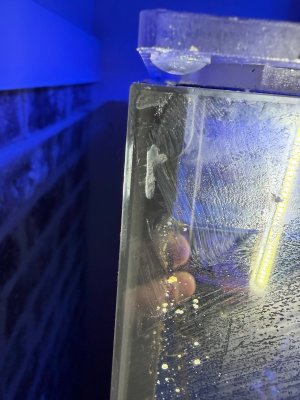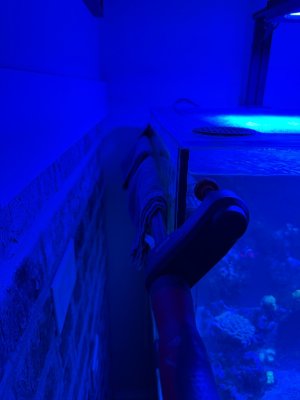

Here’s another post about a Gen 1 Red Sea tank failing. Well, two tanks actually! My neighbor’s Red Sea Reefer 350 blew the front seam and failed a couple weeks ago. That got me looking at new tanks, and a good thing too! Last night I noticed a brand new void in the seam of my Reeder XL 425 (It was NOT there 48 hours prior). You can even see water in it if you push on the glass. Luckily I had gotten quotes on new custom tanks last week. I know of Red Sea’s reputation with Gen 1 tank seam failures, but assumed it was just a statistic. I also told myself that because I dreaded thinking about what’s involved in doing a tank swap.
Now that I’m being forced into needing to fit a new tank in, I’m curious to hear the experiences of others who have replaced/upgraded their tank. My journey will be a bit interesting as I’ll move from a Herbie drain setup to a Bean-animal and have them drill dual returns on either end of the tank. I also do not have the sump under the stand. Instead I have piping through the wall to a fish room behind. So I’ll have to marry up the old plumbing with new additional lines. It also means I’ll need to add a second return pump as my old one was already running at 100% on the Red Sea. The new tank will be about 135 gallons, so a decent step up from 88.
If you have swapped tanks, please share! How did you manage sand? How much water did you transfer and reuse? Mini cycle and fish/corals? Tricks to moving the old tank with stuff still in it? Things to definitely not do?
Now that I’m being forced into needing to fit a new tank in, I’m curious to hear the experiences of others who have replaced/upgraded their tank. My journey will be a bit interesting as I’ll move from a Herbie drain setup to a Bean-animal and have them drill dual returns on either end of the tank. I also do not have the sump under the stand. Instead I have piping through the wall to a fish room behind. So I’ll have to marry up the old plumbing with new additional lines. It also means I’ll need to add a second return pump as my old one was already running at 100% on the Red Sea. The new tank will be about 135 gallons, so a decent step up from 88.
If you have swapped tanks, please share! How did you manage sand? How much water did you transfer and reuse? Mini cycle and fish/corals? Tricks to moving the old tank with stuff still in it? Things to definitely not do?